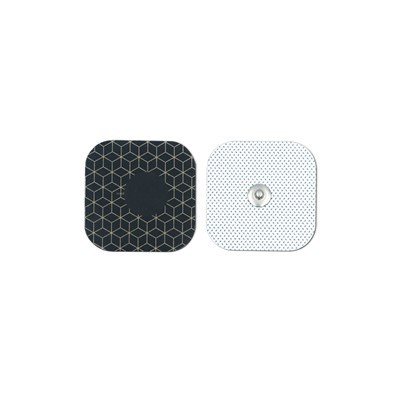


OEM Snap Wireless Electrode Pads | Pod-Docking | TOP-RANK
B2B snap wireless electrode pads engineered for cable-free TENS/EMS pods. Formulated with zero-slump high-cohesion hydrogels and low-profile PU to suspend wearable hardware payloads without dynamic edge-lifting.
Product Overview
These snap wireless electrode pads function as the specialized mechanical and electrical docking interface developed specifically for cable-free, wearable transcutaneous stimulators and digital health pods. Diverging from standard wired pads that only experience passive tension from trailing thin leads , this layout serves as the absolute physical anchor that locks the mass-weight of a battery-powered active device case directly to the mammalian skin barrier. The structural layout is engineered to withstand continuous gravitational leverage and kinetic movement without allowing cross-layer phase separation or localized impedance bottlenecks. We mass-produce these high-density blank templates for consumer health device brands, clinical equipment GPOs, and telehealth accessory chains.
Technical Fabrication & Overmolding Dynamics
The continuous automation of wireless electrode pads paths a multi-layer raw polymer layout past synchronized rotary converting anvils. Winding a hardware-bearing patch requires specialized lamination engineering ; if standard low-viscosity monomer gels are deployed beneath the terminal rivet area, the continuous tilting weight of the docked battery module forces horizontal gel displacement, leading to exposed carbon black lines and instant current tunneling. We counter this physical failure by utilizing an inline ultraviolet (UV) curing grid that forces high-density共价键 cross-linking across the polymer lattice. Before the high-cohesion matrix is cast, a puncture resistant, black Tyvek stabilization ring is layered around the micro-hole. High-tonnage cold-forging pneumatic presses swage the brass stud into this reinforced core with a tear-out rip limit exceeding 35N, ensuring the patch remains structurally intact during repetitive, high-velocity host attachment and removal. Standard wholesale lots carry a 20,000-unit minimum run threshold.
Core Engineering Assets
-
Rigid-Casing Pitch Registration Management
Wireless, split-type EMS toners or wearable mini-TENS pods utilize a rigid plastic exterior shell housing fixed PCB terminals. If the distance between the positive and negative snaps drifts by even 0.3mm due to material stretch during production, the user must force the electronic module into place. This mechanical friction builds internal bending torque, forcing the central bridge of the pad to bow upward, which instantly lifts the outer gel boundaries away from the skin. Our conversion track deploys high-speed inline matrix cameras that monitor cross-direction web tension 100 times per second, locking the dual-snap pitch within an absolute ±0.1mm public tolerance, ensuring the wireless pod snaps entirely flat against the base liner.
-
Zero-Slump Zero-Shear Polyacrylamide Cohesion
A microcurrent or EMS pod worn under clothing on the abdomen, lower back, or thighs faces constant vertical downward force from device mass combined with aggressive lateral shearing during voluntary muscle twitching. Low-grade hydrogels deform plastically under this dual kinetic load, melting into a watery slime that allows the hardware host to slide off. We synthesize our skin-facing layer with an elevated storage modulus (G'). This structural polymer lattice chemically binds water molecules tightly, maintaining its solid-state viscoelastic gel skeleton even when saturated with skin oils and heavy perspiration, absorbing the dynamic payload of the docking module without epidermal separation.
-
Sub-Rivet Current-Tunneling Erasure
Standard wired return pads disperse current across a wide area using an extended, fanned wire array embedded underneath the fabric. Wireless wireless pads, conversely, dump the entire high-mA energy wave directly into the small circular base of a metallic snap rivet. This point-source conduction channels electrons straight downward, creating intense current tunneling that triggers acute thermal skin edge-burns. We eliminate this electrical tracking bottleneck by screen-printing a thick, gradient-compensated silver-carbon busbar trace directly below the riveting perimeter, forcing incoming pulses to scatter horizontally across the edge lines before driving vertically into the hydrogel matrix.
Applications
One-Piece Wearable TENS Kits
Replacement components private-labeled for retail-boxed portable pain-gate hardware where the host docks cleanly onto the pad per session.
Dynamic EMS Athletic Apparel
Flat-profile interfaces designed to snap seamlessly inside active compress garments or muscle-toning belts where external trailing wires are completely eliminated.
High-Motion Clinical Neuromodulation
Reusable dispersive matricespicked for physical therapy centers treating ambulatory patients who require continuous stimulation while moving.
OEM & Private Label
-
Custom Contour Engineering : Human body parts are not flat planes. We engineer custom steel-rule rotary dies into winged, butterfly, or multi-lobed shapes that match the industrial footprint of your proprietary casing, avoiding channel buckling.
-
Global Logistics Routing : Raw polymer compounding, chemical titration, and high-speed carbon trace web screening execute safely in our China plants. Multi-cavity rotary profile slitting,五金铆接 snap-pressing, and automated foil vacuum sealing route through our Vietnam hub, protecting global partners from regional import medical trade duties.
Quality Compliance Data
-
ISO 10993 Dermal Clearing : Compound batches undergo regular clinical-laboratory extractions, validated strictly against ISO 10993-5 (Cytotoxicity Grade 0) and ISO 10993-10 (Primary Dermal Irritation Index < 0.1) limits to confirm absolute safety under sweating garments.
-
MDSAP Audited Converting : Continuous lamination lines and continuous converting lanes function securely within manufacturing networks registered to ISO 13485:2016 and MDSAP regulatory frameworks, facilitating traceable lot-serialization from bulk chemical monomers to the shipping pallet.
FAQ
Q: Why does the host hardware module feel slightly "loose" or swing sideways after a few connection cycles?
A: This mechanical instability indicates a tolerance mismatch in the male stud undercut diameter. If a manufacturing line uses generic, soft tin alloy snaps or uncalibrated riveting dies, the metal head deforms slightly during the first execution of the high-extraction-force decoupling loop. This deformation alters the strict socket dimensions, destroying the rigid lock and introducing micro-arcing. Our lines utilize hard-tempered brass pins machined via precision tooling to retain sub-millimeter metal tolerances across hundreds of snap cycles.
Q: Can we utilize these snap wireless pads for continuous 24-hour diagnostic physiological tracking?
A: It is contraindicated due to material thermodynamic limits. To handle wireless hardware payloads and high-mA EMS motor units, these sheets utilize an integrated gray PU barrier or heavy PET film to reinforce the rivet region, driving the Moisture Vapor Transmission Rate (MVTR) near zero. If worn for over 12 hours, endogenous sweat cannot clear through the fabric, causing severe epidermal softening (maceration) and contact rash points. These interfaces are built specifically for short-duration active physical therapy or muscle conditioning sessions (30 to 60 minutes).
B2B digital therapeutics developers, premium medical procurement networks, and clinical device wholesalers can request high-cohesion rheological datasheets, snap-pitch tolerance plots, and unbranded prototypes for compliance review.
👉 [Request Snap Wireless Pad Samples]
Hot Tags: snap wireless electrode pads, China snap wireless electrode pads manufacturers, suppliers, factory
Specifications
| ITEM | SHAPE | SIZE (CM) | PACKAGING |
|
40*40 |
Square |
4.0*4.0 |
4pcs/pack |
|
50*50 |
Square |
5.0*5.0 |
4pcs/pack |
|
45*95 |
Butterfly |
4.5*9.5 |
2pcs/pack |
|
30*50 |
Tab |
3.0*5.0 |
4pcs/pack |
|
50*90 |
Tab |
5.0*9.0 |
2pcs/pack |