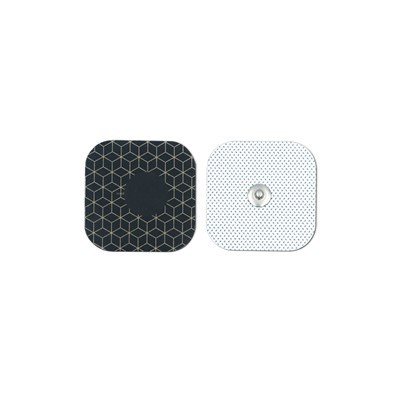


Volume Silicone Conductive Pads | Reusable Carbon Rubber | TOP-RANK
Bulk supply of premium silicone conductive pads (carbon rubber electrodes) for medical physical therapy. Features non-degrading volume resistivity and steam-sterilizable backing.
Engineering Profile
These high-durability silicone conductive pads, also known as carbon rubber electrodes, operate as the baseline reusable conductive interface engineered for clinical electrotherapy setups. Diverging from single-use, hydrogel-dependent patches that dry out after a few applications, these elastomeric plates are vulcanized with medical-grade silicone rubber doped with highly conductive carbon black nanoparticles. This polymer architecture delivers consistent, flat electrical coupling across thousands of therapeutic cycles, resisting physical tearing and chemical degradation from conductive gels. We manufacture these long-life consumables in standard and custom shapes for hospital GPOs, physical therapy equipment brands, and rehabilitation distribution networks.
Synthesis & Elastomer Compounding
The fabrication of these conductive silicone matrices relies on liquid silicone rubber (LSR) or high-consistency rubber (HCR) networks mixed with precisely graded conductive carbon black inside high-shear dispersion kneaders. The primary engineering bottleneck in producing carbon rubber electrodes is preventing "hotspots" caused by carbon agglomeration; if the carbon nanoparticles gather in loose clumps instead of dispersing evenly, the electrical resistance fluctuates violently across the pad surface, creating high-current tunnels that sting the patient. We resolve this by running our polymer compounds through multi-stage cold-feed strainers, ensuring a highly homogenous conductive lattice. The raw composite is then fed into high-pressure injection molding machines, where the 2.0mm female brass sockets are insert-molded directly into the silicone body. This heat-vulcanized bond prevents the metal terminal from pulling free under the strain of continuous cable unplugging. Wholesale OEM contracts start at a 20,000-unit MOQ per size.
Core Engineering Assets
-
Isotropic Volumetric Carbon Dispersion (No-Hotspot Conduction)
Standard silicone electrodes often suffer from uneven carbon loading, resulting in patchy conductivity. Under high-mA muscle stimulation or TENS protocols, the current paths bypass the high-resistance sections, crowding violently into few highly conductive zones. This creates painful, concentrated electrical focus points (hotspots) that burn the patient's epidermis. Our manufacturing lines implement automated planetary planetary mixing, achieving an isotropic dispersion of carbon particles inside the vulcanized silicone. The entire active surface exhibits flat, uniform impedance, delivering clean current distribution (mA/cm^2) without voltage crowding or focal tissue trauma.
-
Dynamic Flex-Recovery Under Tensile Strain
Physical therapy clinics require reusable pads to bend and flex over moving joint topographies, such as the knee or ankle, under the continuous pressure of elastic straps. Flimsy rubber sheets undergo plastic deformation under this stress, micro-cracking at the wire insertion socket and permanently losing connection. We configure our silicone compound with a high-molecular-weight vinyl-siloxane backbone. This structural elastomer offers high tear-strength (>18 kN/m) and dynamic recovery, allowing the pad to flex symmetrically with joint movement, absorbing longitudinal shear force, and snapping back to its flat profile without deformation or circuit cracks.
-
Cross-Sterilization Inertness (Autoclavable Rubber Matrix)
In hospital settings, clinical accessories must undergo rigorous sanitation protocols between patient rotations to prevent cross-contamination. Standard self-adhesive hydrogel pads cannot survive chemical exposure, and cheap rubber electrodes warp and melt under steam. Our medical-grade, carbon-doped silicone is completely inert to autoclaving temperatures up to 134°C and withstands high-concentration chemical disinfectants (such as 75% isopropyl alcohol or sodium hypochlorite). It maintains its structural integrity and volumetric resistivity across hundreds of sanitation cycles without warping, shrinking, or leaching oil.
Downstream B2B Deployments
Hospital Rehabilitation Fleet Tenders
Standard-issue reusable electrodes deployed in public hospital physical therapy wards, where clinical cost-per-use must be minimized through long-term accessory cycles.
Premium Device Manufacturer Bundling
Reusable carbon-rubber pads packaged directly inside clinical-grade muscle stimulators and interferential current (IFC) device retail cartons to provide an immediate heavy-duty setup.
Iontophoresis & High-Voltage Galvanic Therapy
Thermally stable conductive backings designed to handle the continuous direct current (DC) loads required to drive pharmaceutical solutes across the dermal barrier.
Custom Molding & Vietnam Logistics Routing
-
Bespoke Geometry Compress Molding : We support custom molding designs to fit unique hardware contours, such as contoured joint-wrap inserts or pediatric scale shapes. The high-performance steel molds ensure ultra-sharp part parting margins, completely eliminating flash edges that could trap skin oils and bacteria.
-
Vietnam Tariff Shunting Logistics : Raw silicone carbon masterbatch formulation, polymer milling, and chemical stabilizing execute native within our high-capacity China plants. Precision compression injection molding, wire socket insert overmolding, and international packing route via our Vietnam facility, shielding B2B distribution networks from volatile import trade tariffs on medical rubber goods.
Safety & Quality Clearances
-
ISO 10993 Biocompatibility Validation : Samples are regularly evaluated in independent clinical laboratories against strict ISO 10993-5 (Cytotoxicity Grade 0) and ISO 10993-10 (Skin Irritation/Sensitization Index < 0.1) boundaries, ensuring absolute safety for long-window dermal contact even when saturated with conductive gels.
-
MDSAP Certified Facilities : Our cleanrooms and molding bays run strictly under audited ISO 13485:2016 and MDSAP quality frameworks, facilitating full, lot-serialized traceability from raw polymer compounding to the shipping dock.
Technical FAQ
Q: Can we utilize these silicone conductive pads without applying any conductive gel or water wet-out?
A: Absolutely not. Silicone conductive pads are dry elastomers with zero self-adhesive properties. If placed dry against the skin, the micro-air gaps between the rubber surface and the epidermis act as strong dielectric barriers. Attempting to pass current through these dry contacts will spike resistance, causing voltage arcing and immediate, severe skin burns. They must always be paired with a wet sponge cover, water wet-out, or a layer of professional electrode conductive gel.
Q: Why does the volume resistivity of some cheap rubber electrodes rise sharply after a few months of clinical use?
A: This degradation is caused by carbon-polymer phase separation, typical of low-grade compounding. Under high-temperature sanitizing cycles or repetitive mechanical stretching, cheap rubber matrices suffer polymer relaxation, allowing the conductive carbon pathways to drift apart. Our medical-grade silicone utilizes premium cross-linking coupling agents that bind the carbon nanoparticles permanently within the siloxane lattice, guaranteeing stable, low resistivity (<150 Ohm-cm) across years of professional clinical rotation.
B2B clinical distributors, physical therapy equipment OEMs, and hospital procurement networks can request complete Certificates of Analysis (COA), tensile-strength specification datasheets, and trial physical samples for technical auditing.
👉 [Request Silicone Conductive Pad Samples]
Hot Tags: silicone conductive pads, China silicone conductive pads manufacturers, suppliers, factory
Technical Specifications
| Chemical & Physical Property | Targeted Value | Analytical Reality |
| Volume Resistivity | < 150 Ohm-cm | Four-point probe measurement standard |
| Tensile Strength | > 6.5\MPa | ASTM D412 vulcanized rubber test |
| Hardness | 45 - 55 Shore A | Precise balance of skin flex and rigid core |
| Sterilization Limit | Autoclavable (121°C or 134°C) | Chemically inert to alcohol & boiling water |
| Connection Interface | 2.0mm Pin Receptacle / 3.5mm Snap | Precision insert-molded brass-nickel sockets |