



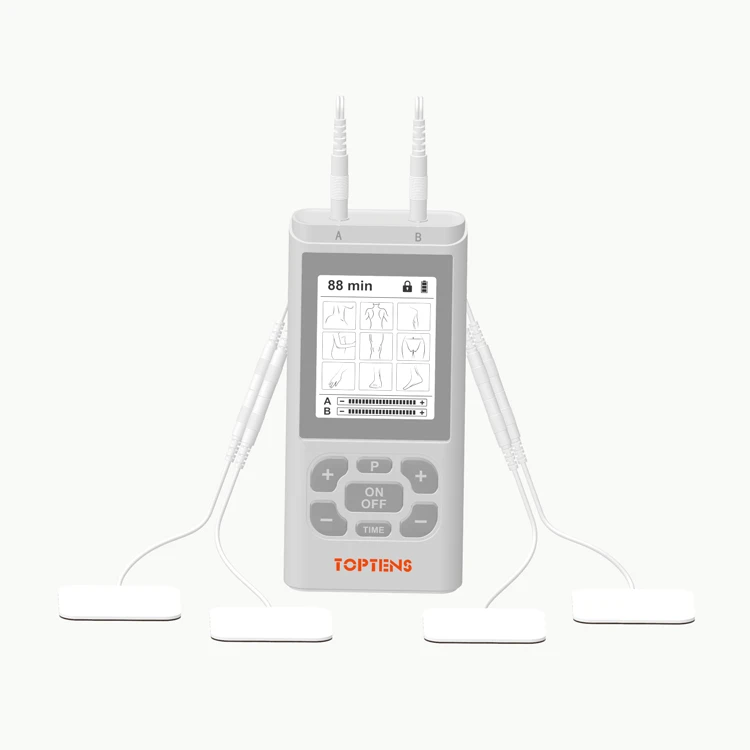
OEM Medical TENS Unit | Prescription Dual-Channel E-Stim | TOP-RANK
B2B contract manufacturing of prescription-grade medical TENS units. Features dual isolated constant-current channels, dynamic compliance boost up to 100V, sub-0.01 uC residual DC charge balance, anti-accommodation rate/width modulation (MRW), lockable physician parameters, and IEC 60601-2-10 compliance.
Product Overview
The medical TENS unit is a prescription-grade, dual-channel transcutaneous electrical nerve stimulator designed for continuous clinical pain management protocols. Unlike consumer-grade over-the-counter (OTC) massagers, this platform is engineered for outpatient orthopedic rehabilitation, hospital acute post-surgical recovery, and long-term Durable Medical Equipment (DME) prescription resupply programs managing intractable axial spinal pain, peripheral diabetic neuropathy, and phantom limb syndrome.
Consumer-grade stimulators consistently fail when deployed in multi-hour clinical prescription settings:
- Output Attenuation from Open-Loop Voltage Driving: Budget OTC units operate on unregulated constant-voltage circuits. Human skin impedance fluctuates continuously between 300 Ohm and 1,800 Ohm depending on skin hydration, ambient temperature, and sebum levels. When applied over dry, keratinized epidermis, constant-voltage circuits cannot deliver sufficient charge to reach the depolarization threshold of deep A-beta sensory nerve fibers ($Q = I \times t$). Conversely, when the patient perspires, impedance collapses, causing current spikes that induce sharp cutaneous pain.
- Rapid Afferent Neural Accommodation: Low-cost stimulators emit repetitive, unmodulated square-wave pulses at static frequencies (e.g., 80 Hz or 100 Hz). The human dorsal horn gate-control mechanism accommodates to this fixed sensory input within 10 to 15 minutes: sodium channels along the A-beta axonal membranes enter an inactivated state, pain signals resume transmission across ascending spinothalamic tracts, and the clinical analgesic effect vanishes.
- Galvanic DC Leakage During Extended Wear: Prescription protocols frequently call for 6 to 12 hours of daily wear. Inexpensive stimulators with asymmetric output transistors permit residual direct-current (DC) drift. Uncompensated ionic migration shifts localized skin pH beneath the electrodes, causing chemical erythema, skin ulceration, and contact burns.
This medical TENS platform features two electrically isolated constant-current output stages powered by a closed-loop 100V compliance rail. The microprocessor dynamically runs Modulated Rate and Width (MRW) and Burst algorithms across 1 Hz to 150 Hz to overcome neural accommodation. The output incorporates series-stacked ceramic DC-blocking capacitors, limiting residual DC offset below 0.01 uC per cycle. Hardware parameter locks and internal 999-hour patient adherence timers fulfill clinical DME billing requirements. We contract-manufacture this platform for medical device distributors, DME resupply providers, and clinical physical therapy brands globally.
Technical & Engineering Description
The industrial manufacturing of this medical TENS unit is carried out in ISO 13485-certified Class 8 cleanrooms utilizing multi-layer surface-mount technology (SMT) and automated test fixtures. The circuitry is laid out on an industrial 4-layer FR-4 printed circuit board (PCB) with separated ground planes for the micro-controller logic, switch-mode power boost, and dual high-voltage output bridges.
The primary power stage utilizes an active DC-DC inductive boost regulator that converts low battery voltage (3.7V Li-ion or 9V alkaline) into an isolated 100V compliance rail. A closed-loop feedback network continuously monitors current output across precision current-sense shunts (0.1% tolerance) at a sampling rate of 100 kHz. When a patient's skin impedance shifts dynamically-from 400 Ohm up to 1,500 Ohm-the microcontroller alters the pulse-width modulation (PWM) of the boost converter within 30 microseconds, scaling compliance voltage to hold the delivered milliampere output constant.
The H-bridge power stage features four discrete low-on-resistance n-channel MOSFETs per channel driven by an ARM Cortex microcontroller core. The switching sequence synthesizes an asymmetrical biphasic pulse: a primary negative phase delivers target therapeutic current, followed by a low-amplitude positive phase of equal integral area. A high-voltage (160V-rated) non-polar ceramic capacitor is wired in series with each pin output, physically blocking direct-current flow and limiting net DC offset below 0.01 uC per cycle.
Galvanic isolation between Channel 1 and Channel 2 is established through independent flyback transformers holding an inter-channel dielectric withstand capability exceeding 3,000V DC, suppressing cross-talk displacement current below 5 uA.
The mechanical housing is injection-molded from medical-grade polycarbonate-ABS alloy with an integrated elastomeric perimeter bumper (drop-tested to withstand 1.5-meter free-fall onto steel). Output sockets are recessed 2.0mm DIN touch-proof female connectors compliant with IEC 60601-1. Each manufactured device undergoes a continuous 48-hour burn-in stress cycle, followed by automated verification across a five-point load matrix (200 Ohm, 500 Ohm, 1,000 Ohm, 1,500 Ohm, and 2,000 Ohm in parallel with 0.1 uF). Automated test equipment logs waveform symmetry, rise time (<1.5 us), and open-circuit cutoff response (<15 ms). The standard minimum OEM contract production run is 5,000 units.
Key Features
-
Closed-Loop Active Compliance Regulation (Constant-Current Depolarization Across Dynamic Impedance Fluctuations)
In clinical usage, a patient's transcutaneous impedance is not a fixed resistance: as skin dries or sweats during multi-hour wear, load resistance shifts between 300 Ohm and 1,800 Ohm. On constant-voltage stimulators, this causes current to collapse (dropping below the depolarization threshold) or spike uncontrollably. Our output stage pairs an active 100V inductive boost converter with a 100 kHz closed-loop current sensing network. When dry skin increases resistance, the microcontroller steps up compliance voltage within 30 microseconds, delivering the required voltage overhead to maintain current output ($I = V/R$). When sweating lowers impedance, the regulator steps down compliance voltage, preventing current surges. The dialed therapeutic current remains stable across movements, postural shifts, and drying hydrogel interfaces.
-
Zero-Residual Direct-Current Capacitive Coupling (Sub-0.01 uC Symmetrical Charge Balance for Multi-Hour Dermal Integrity)
Long-duration prescription protocols (up to 12 hours daily) present severe dermal electrochemical risks: minor timing skews in bridge-driver transistors generate residual direct-current (DC) offsets. Over hours of continuous stimulation, this net DC component causes unidirectional ion drift within the epidermis, altering local pH and causing chemical burns, follicular necrosis, and dermal erythema beneath the electrodes. We eliminate galvanic direct-current migration through dual design controls. First, the H-bridge switching firmware executes an asymmetrical biphasic waveform where the primary negative stimulation phase is actively neutralized by a symmetrical secondary recharge phase. Second, non-polar ceramic capacitors rated for 160V are wired in series directly before the DIN output terminals. This creates an open circuit to direct current: charge passes only as an alternating displacement current. Net DC charge accumulation is restricted below 0.01 uC per cycle, preventing electrochemical polarization and dermal breakdown across extended home prescription treatments.
-
Algorithmic Rate-Width Stochastic Modulation (Preventing A-Beta Sensory Gating Habituation)
Continuous single-frequency stimulation causes sensory adaptation: when nociceptive interneurons in the substantia gelatinosa of the dorsal horn receive monotonous A-beta inputs, presynaptic inhibition decreases as sensory axons undergo habituation. The patient experiences fading paresthesia, and chronic pain signals break through the neural gate. Our firmware incorporates Modulated Rate and Width (MRW) and Strength-Duration (SD1/SD2) algorithm engines. The processor continuously sweeps pulse frequency (from 50 Hz to 120 Hz) while inversely modulating phase duration (from 250 us down to 60 us) in continuous 6-second sinusoidal or random stochastic cycles. As frequency accelerates, pulse width narrows to keep total delivered charge constant, preventing sharp prickling sensations while continually altering the sensory firing pattern. The dorsal horn interneurons remain active, providing continuous presynaptic pain gating across multi-hour clinical sessions without requiring manual re-adjustment.
Applications
Post-Operative Acute Orthopedic Analgesia
Bedside prescription devices deployed following total knee arthroplasty (TKA), rotator cuff repairs, and lumbar fusion, reducing patient reliance on opioid analgesics while mobilizing joints without systemic sedation.
DME / HME Insurance Reimbursement Resupply Kits
Turnkey clinical stimulators qualifying under Medicare Part B HCPCS code E0720 (two-lead TENS) and E0730 (four-lead TENS), configured with lockable physician compliance menus and tamper-evident run timers for monthly DME insurance resupply billing.
Neuropathic Intractable Pain Centers
Multi-protocol units prescribed for outpatient management of refractory diabetic peripheral neuropathy (DPN), post-herpetic neuralgia (PHN), and complex regional pain syndrome (CRPS) requiring extended home therapy.
OEM & Private Label
-
Tamper-Evident Housing, Clinician Lockouts & Custom Bundling : We support custom tool fabrication for handheld enclosures with integrated belt clips, drop-resistant silicone jackets, and large-format high-contrast displays. Firmware supports custom clinical lock modes: clinicians set maximum mA limits, lockout therapy modes via secret key combinations, and extract verified run-time adherence logs. Packaging options include clinician-grade hard-shell EVA transport cases, drop-tested corrugated cartons, or tamper-evident clamshell retail packaging bundled with private-labeled leadwires and hydrogel electrode pads.
-
Two-Center Supply Chain Mechanics : High-precision SMT surface-mount fabrication, custom planar pulse transformer winding, MCU firmware programming, and primary board-level testing execute natively inside our primary China facility. Mechanical chassis injection molding, display module assembly, lithium-ion battery integration, 48-hour burn-in stress calibration, final cleanroom packaging, and global ocean container palletization route through our Vietnam hub, shielding international B2B buyers from regional medical device tariffs and Section 301 duties.
Certifications
-
ANSI/AAMI NS4 & IEC 60601-2-10 Electrical Rigor : Production master units undergo testing in accredited independent testing laboratories confirming strict compliance with ANSI/AAMI NS4 (Transcutaneous electrical nerve stimulators), IEC 60601-1 (General medical safety, Class II, Type BF applied parts), IEC 60601-1-2 (EMC Class B), and IEC 60601-2-10. Output current limits, maximum phase energy ceilings (<300 mJ into 1,000 Ohm), and open-circuit cutoff boundaries are interlocked in hardware.
-
MDSAP & ISO 13485 Certified Manufacturing Systems : Cleanroom assembly suites, electronic testing decks, and packaging bays operate strictly within facilities certified to ISO 13485:2016 and MDSAP regulatory frameworks (covering US FDA, Health Canada, TGA Australia). Unbroken electronic Device History Records (DHR) trace every discrete semiconductor, pulse transformer, and passive resistor from incoming inspection reels to outbound master shipping cartons.
Technical FAQ
Q: Why does open-loop constant-voltage driving fail in prescription neuropathic pain management, and how does the 100V compliance rail maintain constant-current delivery across dry skin?
A: Depolarizing cutaneous sensory axons depends strictly on charge density (Q = I × t) delivered per phase. In open-loop constant-voltage devices, output current varies inversely with tissue resistance (I = V / R). Human stratum corneum contains a dense, keratinized lipid matrix that presents high initial static impedance (1,200Ω to 1,800Ω), especially in elderly neuropathic patients with dry skin. When driven by a standard 30V or 50V constant-voltage stimulator, delivered current drops below 15 mA; this falls below the threshold required to recruit deep, large-diameter A-beta sensory fibers, rendering the treatment ineffective. Conversely, when the patient sits down or perspires, sweat salts flood the skin crevices, dropping impedance below 400 Ohm and causing current to spike into painful ranges. Our unit resolves this through an active 100V compliance rail coupled to a 100 kHz closed-loop constant-current stage. When high skin resistance (1,500Ω) is encountered, the inductive boost converter steps the rail up to 100V peak-to-peak within 30 microseconds, providing the electromotive force required to drive the selected therapeutic current (e.g., 60 mA into 1,500 Ohm requires V = 0.06 × 1,500 = 90V). Current delivery remains clamped to the target milliampere value regardless of whether the skin is dry, moist, or undergoing movement.
Q: How does the Modulated Rate and Width (MRW) algorithm bypass dorsal horn habituation at the neuronal synapse level?
A: The analgesic action of conventional TENS relies on Melzack and Wall's Gate Control Theory: non-nociceptive inputs from low-threshold myelinated A-beta fibers stimulate inhibitory interneurons in the substantia gelatinosa of the dorsal horn, presynaptically suppressing C and A-delta nociceptive input into transmission (T) cells. However, when stimulated with an unvarying pulse train (e.g., constant 100 Hz, 150 us), voltage-gated sodium channels along the sensory axon enter a prolonged refractory state, while synaptic vesicles at inhibitory interneuron junctions deplete their GABA and glycine neurotransmitter stores. This habituation abolishes the presynaptic inhibitory barrier within 15 minutes. Our Modulated Rate and Width (MRW) algorithm counteracts synaptic fatigue by continuously varying both time-domain and frequency-domain parameters. Over a 6-second cycle, the microprocessor sweeps pulse frequency from 50 Hz up to 120 Hz while inversely sweeping pulse width from 250 us down to 60 us. This continuous parameter sweep alters the inter-spike interval and depolarizing charge packet delivered to the sensory terminal. Axonal sodium channels recover during the wider, lower-frequency phases, and neurotransmitter exocytosis at the inhibitory synapse remains active. Presynaptic inhibition of nociceptive T-cells is maintained across multi-hour clinical sessions without therapeutic decay.
Orthopedic clinic directors, DME billing contractors, and physical therapy hardware brand operators can request complete ANSI/AAMI NS4 electrical compliance dossiers, closed-loop load regulation oscillograms, and functional unbranded evaluation units with clinical leadwire and electrode accessory packages.
👉 [Request Medical TENS Unit Evaluation Samples]
Hot Tags: medical tens unit, China medical tens unit manufacturers, suppliers, factory, TENS Unit Machine, best TENS unit, transcutaneous electrical nerve, Stim Machine, electro nerve stimulator, TENS lower back pain electrode placement
Specifications
|
Device name |
TENS-806 |
|
Power sources |
3.7 V Li-ion battery |
|
Power supply |
Input: 100-240V AC, 50/60Hz,0.2A; Output: 5V DC, 300mA |
|
Output channel |
Dual channel |
|
Waveform |
Bi-phase square-wave pulse |
|
Output current |
Max. 120mA (at 500ohm load) |
|
Output intensity |
0 to 40 levels, adjustable |
|
Treatment mode |
TENS,EMS |
|
Number of programs |
26 program |
|
Pulse rate |
2Hz ~ 120Hz |
|
Pulse width |
50uS ~ 300uS |
|
Treatment time |
5 minutes ~ 90 minutes |
|
Operating condition |
5° C to 40° C with a relative humidity of 15%-93%, |
|
Storage condition |
-10° C to 55° C with a relative humidity of 10%- |
|
Dimension |
109*55*18mm (L x W x T) |
|
Weight |
About 73g |
|
Automatic shutof |
1 minute |
|
Classification |
BF type applied part, internal power equipment, IP22 |
|
Size of electrodes pad |
40x40mm, square |
|
Output precision |
±20% error is allowed for all the output parameters |


