
OEM TENS EMS Machine | Dual-Channel Hardware | TOP-RANK
B2B dual-modality TENS and EMS machines. Engineered with isolated step-up transformers and MCU-driven waveform switching for concurrent pain gating and motor unit recruitment.
Product Overview
This hardware is a dual-modality pulse generator integrating both Transcutaneous Electrical Nerve Stimulation (TENS) and Electrical Muscle Stimulation (EMS) into a single printed circuit board assembly (PCBA). Engineered for clinical rehabilitation and OTC sports medicine, the device utilizes a central microcontroller (MCU) to shift between sensory nerve gating (high-frequency, narrow pulse width) and motor unit recruitment (low-frequency, wide pulse width). We manufacture this combined electrotherapy hardware for physical therapy distributors, chiropractic networks, and wearable technology brands.
Technical/Engineering Description
The PCBA is built around a dynamic MCU capable of synthesizing asymmetrical biphasic square waves. Because TENS and EMS require fundamentally different electrical vectors, the firmware is programmed with distinct parameter guardrails. When toggled to TENS, the MCU restricts the pulse width to prevent involuntary muscle twitching. When switched to EMS, it forces wide pulse widths and initiates pre-programmed Duty Cycles (Ramp-Up, Hold, Ramp-Down, Rest) to prevent lactic acid toxicity during muscle tetany. The dual-channel output is magnetically isolated at the hardware level, preventing stray current crossover. Standard OEM tooling runs dictate an MOQ of 2,000 units.
Key Features
-
Dual-Channel Magnetic Isolation
Non-isolated circuits allow voltage leakage between Channel A and Channel B. If placed across the torso, this leakage creates a dangerous electrical bridge through the chest cavity. This PCBA mounts two independent discrete step-up transformers. The electrical load for each channel is magnetically separated. This physical isolation allows a clinician to run a high-mA EMS protocol on a patient's quadriceps while simultaneously running a low-mA TENS protocol on their lower back, with zero cross-channel interference.
-
Modality-Specific Waveform Modulation
A machine cannot simply increase intensity to switch from pain relief to muscle building; it must alter the wave structure. Sensory nerves react to short bursts, while motor nerves require sustained energy. The firmware instantly modifies the wave geometry upon mode selection. TENS modes are locked under 100$\mu$s to strictly gate pain signals at the spinal cord level. EMS modes expand the pulse width beyond 200$\mu$s, providing the sustained electromotive force required to physically bridge the neuromuscular junction and contract the muscle belly.
-
Closed-Loop Impedance Cutoff
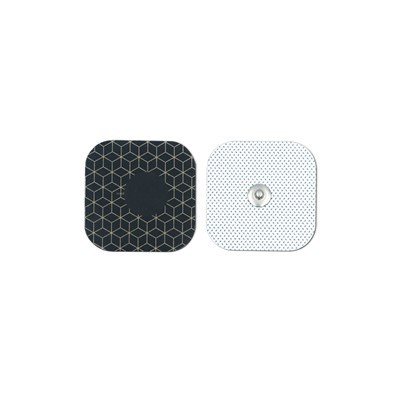
During heavy EMS muscle twitching, kinetic movement can cause the hydrogel pad to partially peel off the skin. This suddenly reduces the conductive surface area, causing the constant current to concentrate into a focal point, instantly burning the epidermis. The hardware utilizes an active feedback loop that continuously samples the transdermal resistance. If the impedance suddenly spikes beyond a safe threshold (indicating pad detachment), the MCU zeroes the output transistors to 0mA within milliseconds, aborting the shock vector.
Applications
Orthopedic Rehabilitation
Utilizing EMS to prevent disuse atrophy in casted limbs, paired with TENS to manage post-operative joint pain.
Athletic Training Supplement
Firing Type II fast-twitch fibers via EMS during resistance protocols, followed by low-frequency TENS (Endorphin release) for recovery.
Chronic Neuropathy
Daily sensory nerve gating for sciatica or diabetic neuropathy without the gastrointestinal side effects of oral analgesics.
OEM & Private Label
-
Firmware Hard-Coding: We can rewrite the MCU firmware to lock specific frequency ranges, hard-code proprietary EMS contraction/rest duty cycles, or restrict the maximum mA output to comply with specific regional OTC regulations.
-
Logistics Routing: PCBA fabrication, component SMT, and firmware flashing execute in China. Final enclosure assembly, QA bench testing, and retail boxing operate through our Vietnam facility to manage supply chain resilience and optimize global electronics import tariffs.
Certifications
-
Regulatory Support : Hardware schematics, PCB layouts, and MCU validation reports support B2B clients in filing for FDA 510(k) Class II and CE (MDR) market clearance.
-
Systems : Assembly and electrical safety testing operate strictly within audited ISO 13485:2016 frameworks.
FAQ
Q: Why does the device automatically drop the intensity to 0 mA when switching
A: This is a critical firmware safety interlock. TENS operates at a narrow pulse width, while EMS utilizes a wide pulse width. An intensity of 40mA feels like a gentle tingle in TENS mode (100μs). If the user switched directly to EMS mode (250μs) without resetting the amplitude, that same 40mA would carry 2.5 times the electrical energy, causing a violent, painful muscle spasm.
Q: Can TENS and EMS waveforms be output simultaneously on the exact same channel?
A: No. A single transformer and output transistor set cannot synthesize a 100μs pulse and a 250μs pulse at the exact same millisecond. However, because the machine features dual isolated channels, Channel A can run a TENS protocol while Channel B runs an EMS protocol simultaneously on different body parts.
B2B physical therapy distributors and clinical hardware brands can request dual-channel PCBA prototypes and waveform oscilloscope reports.
👉 [Request TENS/EMS Machine Prototypes]
Hot Tags: tens ems machine, China tens ems machine manufacturers, suppliers, factory
Specifications
|
Device name |
TENS-806 |
|
Power sources |
3.7 V Li-ion battery |
|
Power supply |
Input: 100-240V AC, 50/60Hz,0.2A; Output: 5V DC, 300mA |
|
Output channel |
Dual channel |
|
Waveform |
Bi-phase square-wave pulse |
|
Output current |
Max. 120mA (at 500ohm load) |
|
Output intensity |
0 to 40 levels, adjustable |
|
Treatment mode |
TENS,EMS |
|
Number of programs |
26 program |
|
Pulse rate |
2Hz ~ 120Hz |
|
Pulse width |
50μS ~ 300μS |
|
Treatment time |
5 minutes ~ 90 minutes |
|
Operating condition |
5° C to 40° C with a relative humidity of 15%-93%, |
|
Storage condition |
-10° C to 55° C with a relative humidity of 10%- |
|
Dimension |
109*55*18mm (L x W x T) |
|
Weight |
About 73g |
|
Automatic shutof |
1 minute |
|
Classification |
BF type applied part, internal power equipment, IP22 |
|
Size of electrodes pad |
40x40mm, square |
|
Output precision |
±20% error is allowed for all the output parameters |