



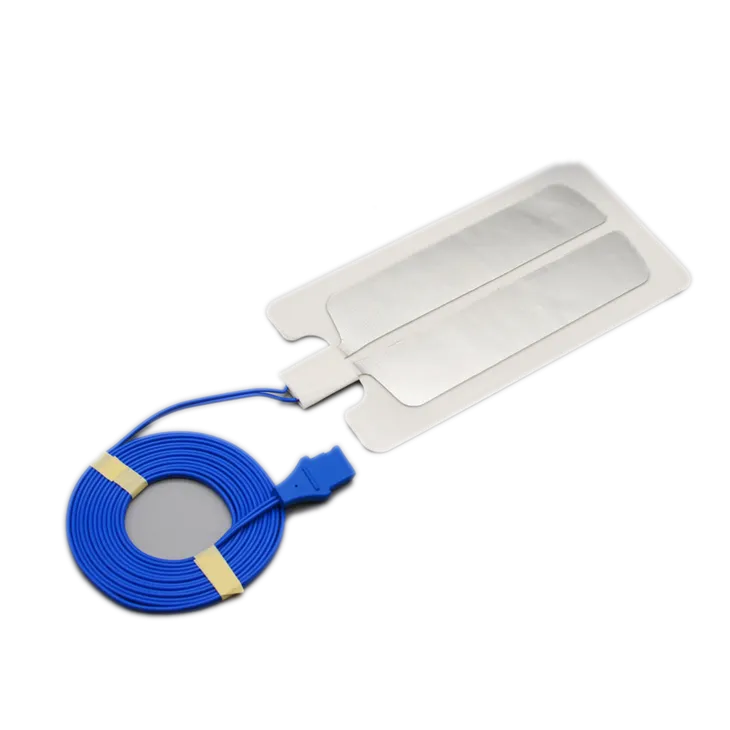


OEM Electrical Grounding Pad | ESU Patient Plate | TOP-RANK
B2B electrosurgical grounding pads. Engineered with equipotential aluminum foil geometry and CQM-compatible split architectures to disperse high-frequency RF current and prevent localized thermal burns.
Product Overview
The electrical grounding pad (neutral electrode) is a critical transdermal safety interface used during monopolar electrosurgery. When a surgical pencil cuts or coagulates tissue, it drives high-frequency radio frequency (RF) current (300kHz to 3MHz) into the patient. This pad acts as the mandatory low-impedance exit point, capturing the thermal electrical energy and safely routing it back to the Electrosurgical Unit (ESU) generator. We manufacture these large-format conductive substrates for hospital procurement networks and B2B electrosurgical hardware OEMs.
Technical/Engineering Description
The pad's architecture is a multi-layer lamination optimized for extreme thermal energy dissipation. The structural base is a fluid-resistant closed-cell PE foam. An oversized aluminum foil sheet is die-cut and laminated onto the foam to serve as the primary RF collector. A thick layer of hyper-conductive polyacrylamide hydrogel encapsulates the aluminum trace. The gel establishes a 100% void-free fluid bridge against the skin's microscopic topography, mathematically diluting the current density below the 1.5 W/cm² biological threshold for thermal burns. Automated roll-to-roll manufacturing executes strictly under IEC 60601-2-2 high-frequency surgical safety standards. We require customised aluminium foil bags, with a MOQ of 10,000.
Key Features
-
Equipotential Ring Geometry & Edge-Effect Mitigation
High-frequency RF current does not flow evenly across a flat metal surface; it physically crowds at the sharp outer edges and corners (the edge-effect). If a grounding pad utilizes a standard rectangular foil, the current density spikes at the corners, instantly causing localized third-degree burns on the patient's thigh or back. The aluminum foil trace inside this pad is die-cut into a specific figure-eight or equipotential ring geometry. This shape eliminates sharp structural corners and forces the returning RF current to disperse radially and equally across the center of the hydrogel mass.
-
Split-Pad CQM/REM Interlocking
Modern ESUs employ Contact Quality Monitoring (CQM) or Return Electrode Monitoring (REM) systems. These generators require a "Split" grounding pad, where the aluminum foil is physically divided into two separate conductive zones. The ESU constantly measures the internal impedance between zone A and zone B. If the pad begins to peel off the patient due to surgical fluid ingress or pulling, the contact area shrinks, and the inter-zone impedance spikes. The hardware detects this resistance shift in milliseconds and aborts the monopolar output, neutralizing the burn vector before thermal damage occurs.
-
Hydrophobic Perimeter Sealing
Operating rooms present high-fluid environments (blood, saline irrigation, iodine). If these conductive liquids seep under the grounding pad, they bypass the uniform hydrogel layer and create an uncontrolled, high-current short-circuit directly to the aluminum foil. This substrate is engineered with an oversized, 15mm closed-cell PE foam margin extending beyond the hydrogel boundary. This hydrophobic dam utilizes a high-tack acrylic medical adhesive to create an absolute watertight seal against the epidermis, structurally locking fluids out of the active RF zone.
Applications
Monopolar Electrosurgery
Standard return vector for deep tissue cutting and coagulation using Valleylab, Bovie, or Erbe ESU generators.
RF Ablation Procedures
Sustained low-impedance grounding during prolonged cardiac or tumor ablation thermal cycling.
Veterinary Surgery
Modified high-tack foil matrices deployed across shaved dermis to manage unpredictable kinetic movement during veterinary monopolar cutting.
OEM & Private Label
-
Regulatory: Thermal performance and impedance metrics are validated strictly against IEC 60601-2-2 mandates to support OEM Class IIb/Class III regulatory submissions.
-
Systems: Lamination tracks and RF quality control operate completely within audited ISO 13485:2016 cleanroom environments.
Certifications
-
Regulatory : Thermal performance and impedance metrics are validated strictly against IEC 60601-2-2 mandates to support OEM Class IIb/Class III regulatory submissions.
-
Systems : Lamination tracks and RF quality control operate completely within audited ISO 13485:2016 cleanroom environments.
FAQ
Q: Can a hospital use a Solid (Non-REM) pad on a modern ESU machine with Contact Quality Monitoring?
A: No. A machine with an active CQM/REM system requires a split pad to measure the impedance loop between the two separate foil zones. Plugging a solid pad into a REM-enabled machine will immediately trigger an open-circuit fault algorithm, and the generator will refuse to output cutting power.
Q: Why does the pad have to be discarded if it is applied, removed to shave the patient, and then reapplied?
A: Removing the pad permanently fractures the internal cross-linking of the hydrogel and traps dead skin cells and air pockets on the surface. Reapplying it creates microscopic dielectric air gaps over the aluminum foil. When high-frequency RF current hits these air gaps, it jumps the void as an arc plasma, causing severe point-burns. The pad is strictly single-use to maintain a 100% void-free current path.
B2B surgical supply distributors and ESU hardware brands can request Solid/Split pad prototypes and IEC 60601-2-2 thermal test reports.
👉 [Request Grounding Pad Prototypes]
Hot Tags: electrical grounding pad, China electrical grounding pad manufacturers, suppliers, factory, disposable cautery pad, Disposable Grounding Pads, Surgery Grounding Pad, electrosurgical pad, Grounding Pad, electrocautery pads
Specifications
|
Serial Number |
Model |
Size |
Single or Split |
Whether the cable is connected |
Applicable Group |
|
1 |
EP01 |
150mm×90mm |
Single |
NO |
Children |
|
2 |
EP02 |
150mm×90mm |
Split |
NO |
Children |
|
3 |
EP03 |
210mm×100mm |
Single |
NO |
Adult |
|
4 |
EP04 |
210mm×100mm |
Split |
NO |
Adult |
|
5 |
EI01 |
135mm×180mm |
Single |
NO |
Adult |
|
6 |
EI03 |
135mm×180mm |
Split |
NO |
Adult |
|
7 |
EC04 |
210mm×100mm |
Split |
YES |
Adult |
|
8 |
EI04 |
210mm×100mm |
Split |
YES |
Adult |


