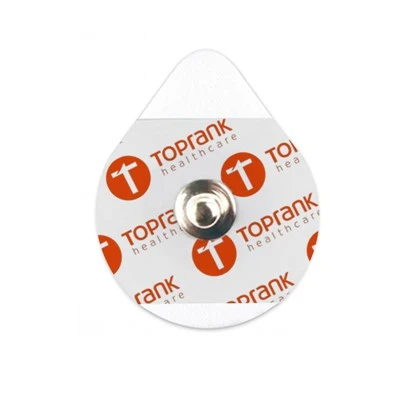

OEM Non-Woven ECG Electrodes | Breathable EKG Pads | TOP-RANK
B2B wholesale non-woven ECG electrodes for extended 48-72 hour inpatient telemetry. Engineered with high-MVTR spunlace backings, low-drift Ag/AgCl sensors, and sub-70 Ohm impedance.
Clinical & Physical Profile
These non-woven ECG electrodes operate as breathable, extended-wear bio-potential sensor interfaces engineered explicitly for general inpatient wards, step-down telemetry units, sub-acute recovery, and long-term Holter monitoring. Managing continuous cardiac telemetry over 48 to 72 hours presents a distinct physiological and adhesive hurdle: standard closed-cell foam electrodes form an occlusive moisture trap. Perspiration and metabolic vapors cannot escape, causing skin maceration (whitening and softening of the stratum corneum), which leads to premature adhesive delamination, baseline signal wander, and localized contact dermatitis. This non-woven electrode replaces impermeable foam with a hydro-entangled, micro-porous spunlace non-woven backing delivering a high moisture vapor transmission rate (MVTR > 1,800\text{ g/m²/24h). Paired with a micro-sputtered silver/silver-chloride (Ag/AgCl) sensor core and an anti-desiccation ionic hydrogel, the assembly conforms smoothly to patient respiratory movement while keeping the skin-electrode interface dry and electrically stable (<70Ω at 10Hz). We manufacture these converting-ready sensor blanks for hospital supply distributors, patient monitoring OEMs, and telemetry packagers globally.
Manufacturing Kinetics & Breathable Web Converting
The industrial fabrication of non-woven ECG electrodes combines high-speed roll-to-roll (R2R) web converting, breathable pattern adhesive coating, sensor eyelet staking, and cleanroom hydrogel dispensing. Optical-grade, cross-laminated spunlace non-woven (55g/m²) is coated with a medical-grade, hypoallergenic acrylic pressure-sensitive adhesive (PSA) applied in a porous pattern to preserve the fabric's open-pore structure. Solid stainless-steel snap studs and conductive Ag/AgCl-sputtered ABS eyelets are mechanically staked through the center of the carrier with high-tonnage precision presses, locking the half-cell potential (Eº = +0.222V). A high-cohesion, polyacrylamide solid hydrogel loaded with pharmaceutical humectants and dissociated alkali chloride electrolytes is slot-die extruded into the central sensing pool. High-speed rotary die-cutters stamp out circular (50mm or 55mm) or teardrop contours with smooth perimeter radii. The finished electrodes are shingled onto siliconized PET release cards and sealed into high-barrier AL/PE foil pouches under ISO 13485 cleanroom controls. The minimum contract manufacturing threshold is 300,000 units.
Core Engineering Assets
-
Microporous Spunlace Vapor Venting (Anti-Maceration Defense Over 72-Hour Wear)
Extended telemetry monitoring with occlusive foam pads traps sweat underneath the electrode, causing the outer stratum corneum to over-hydrate, soften, and separate from underlying epidermal layers. This maceration spikes electrical noise and creates raw, weeping skin tears when pads are removed. Our non-woven electrode uses a hydro-entangled spunlace matrix delivering an MVTR exceeding 1,800 g/m²/24h. The microporous textile allows liquid perspiration to evaporate continuously into ambient air, maintaining a balanced skin-gel boundary that prevents tissue softening and supports unbroken 72-hour telemetry without edge lift.
-
Conformal Multidirectional Elasticity (Decoupled Respiration & Torso Articulation)
Bed-bound and ambulatory telemetry patients continuously expand their rib cages during tidal breathing (12 - 20 breaths/min) and turn in bed. Rigid electrodes resist this continuous stretching, creating mechanical shear at the perimeter that causes tension blisters and false-alarm motion artifacts. We formulate our non-woven backing with a cross-laminated fiber matrix that yields elastically in both longitudinal and transverse axes (>30% stretch recovery). The backing conforms directly to shifting skin folds without pulling, dissipating mechanical cable tension across the fabric matrix to keep the central sensing element stable.
-
Non-Polarizing Stoichiometric Ag/AgCl Core (Sub-4mV DC Offset for Stable ST Baselines)
Extended monitoring exposes electrodes to minor patient movements and static charges that polarize low-grade metal sensors, producing slow baseline drift that confounds automatic arrhythmia detection algorithms. Our electrode integrates a micro-sputtered Ag/AgCl sensor eyelet with tightly controlled stoichiometric chloridation. The reversible half-cell junction keeps post-defibrillation DC offset voltages below 4.0mV and drift rates under 10µV/s. The stable electrochemical baseline allows digital telemetry monitors to track true cardiac morphology-including subtle ST elevations and tiny P waves-without wandering off-screen.
Clinical & Inpatient Deployments
General Medical-Surgical & Telemetry Wards
Standardized 48-to-72 hour monitoring electrodes deployed by ward nurses for continuous ECG rhythm and respiration telemetry in stable hospitalized patients.
Step-Down & Intermediate Care Units (IMC)
Breathable, anti-maceration electrodes used for intermediate-stage cardiovascular patients requiring multi-day ambulatory telemetry before hospital discharge.
Pediatric & Diaphoretic Patient Monitoring
Gentle-release non-woven sensors applied to pediatric patients and febrile, sweat-prone adults where foam backings cause skin tearing and maceration.
Precision Packaging & Global Supply Routing
-
Zero-MVTR Barrier Pouching : Breathable non-woven hydrogels require strict internal moisture retention during storage to prevent dry-out. Electrodes are shingled in strips of 30 or 50 on siliconized release cards and sealed in heavy multi-layer PET/AL/PE foil pouches with 8mm hermetic heat seals, driving Moisture Vapor Transmission Rates (MVTR) near zero to guarantee a 24-month warehouse shelf life.
-
Transnational Logistics Resilience : Spunlace coating, Ag/AgCl sensor sputtering, and hydrogel compounding execute natively inside our primary China facility. High-speed precision die-cutting, terminal eyelet staking, and automated pouch packaging route through our Vietnam hub, protecting global B2B procurement networks from regional medical component trade tariffs.
Quality, Regulatory & Biocompatibility Systems
-
ANSI/AAMI EC12 & ISO 10993 Dermal Safety Clearance : Electrode batches undergo continuous batch validation against ANSI/AAMI EC12 electrical requirements, as well as ISO 10993-5 (Cytotoxicity Grade 0), ISO 10993-10 (Sensitization: 0% allergic response), and ISO 10993-23 (Primary Dermal Irritation Index < 0.1) boundaries, confirming zero skin irritation over 72-hour continuous inpatient wear.
-
MDSAP Certified Cleanroom Manufacturing : R2R converting, hydrogel extrusion, and automated packaging lines operate strictly under ISO 13485:2016 and MDSAP regulatory frameworks, delivering unbroken lot-serialization from raw non-woven webs to outbound shipping pallets.
Technical FAQ
Q: Why are non-woven ECG electrodes significantly better than foam electrodes for 48-to-72 hour inpatient telemetry?
A: Foam electrodes utilize closed-cell, impermeable structures that trap sweat against the skin. Over 48 hours, trapped moisture macerates (softens and breaks down) the stratum corneum, causing the adhesive to slip, spiking impedance, and tearing fragile skin upon removal. Non-woven electrodes feature hydro-entangled micro-pores (MVTR > 1,800 g/m²/24h) that allow perspiration to evaporate naturally, preserving epidermal health and maintaining strong adhesion across multi-day stays.
Q: How does the pattern-coated adhesive maintain high peel strength (3.8N–5.2N) without blocking moisture vapor breathability?
A: Solid-flood adhesive coating forms a continuous rubbery film that seals the pores of non-woven fabric, destroying its breathability. We apply medical acrylic adhesive via micro-patterned slot dies that deposit adhesive in a fine lattice mesh. This creates continuous adhesive anchor points across the skin while leaving unblocked micro-channels throughout the fabric, achieving high peel strength without compromising the backing's 1,800 g/m²/24h MVTR rating.
Hospital procurement directors, telemetry nurse managers, and patient monitoring hardware OEMs can request ANSI/AAMI EC12 electrical degradation test logs, MVTR breathability test reports, and unbranded evaluation sample packs.
👉 [Request Non-Woven ECG Electrode Samples]
Hot Tags: non-woven ecg electrodes, China non-woven ecg electrodes manufacturers, suppliers, factory, Ecg Electrode, Ecg Electrode Stickers, electrode stickers
Technical Specifications
| Analytical Parameter | Target Baseline | Testing Standard |
| Wear Duration | 48 to 72 Hours Continuous Monitoring | In-vivo telemetry sweat-retention assay |
| Dermal MVTR | > 1,800 g/m²/24h | Inverted cup moisture transmission test |
| AC Contact Impedance | < 70 Ohms at 10Hz | Four-point probe planar measurement |
| DC Offset Voltage | < 4.0 mV | ANSI/AAMI EC12 post-defibrillation limit |
| Dynamic Peel Adhesion | 3.8N - 5.2N / 25mm | ASTM D3330 dynamic continuous wear |
| Substrate Carrier | 55g/m² Hydro-Entangled Spunlace | Breathable multi-directional stretch web |
| Connector Type | 4.0mm Stainless Steel Snap Stud | Precision-machined, corrosion-resistant |