

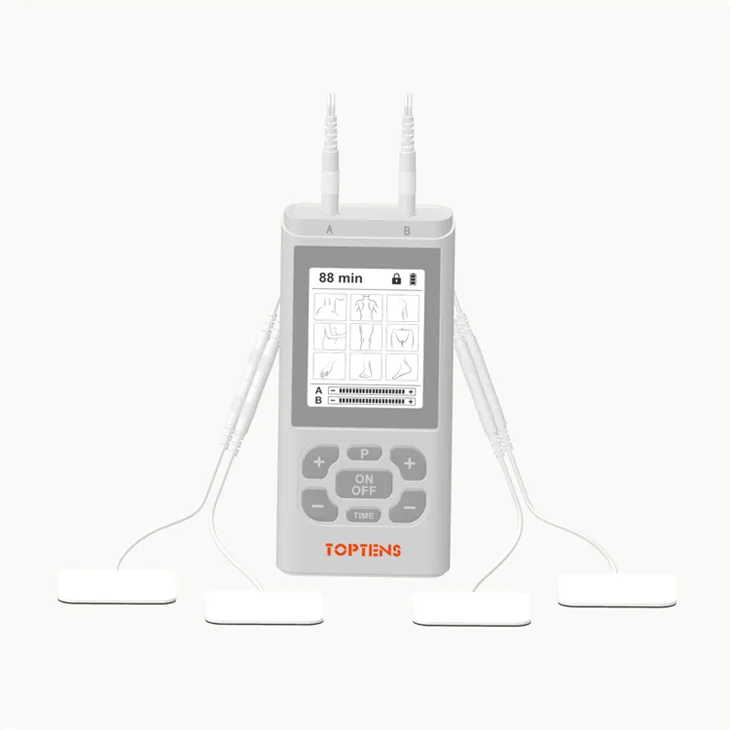
OEM Dual Channel TENS Unit | Isolated Transformers | TOP-RANK
B2B dual-channel TENS units. Engineered with independent discrete step-up transformers and asynchronous MCU control to prevent cross-channel voltage leakage during asymmetric loading.
Product Overview
This dual-channel TENS unit is a clinical-grade neuromodulation hardware platform featuring two electrically isolated output circuits (CH1 and CH2). Unlike low-cost single-transformer parallel splitters, this PCBA mounts two independent magnetic cores. This architectural division allows the hardware to drive two distinct biological loads simultaneously without voltage dropping or signal interference. We supply these true dual-channel pulse generators to physical therapy equipment distributors, chiropractic networks, and OTC medical device brands.
Technical/Engineering Description
The hardware utilizes a centralized microcontroller unit (MCU) that allocates distinct digital registers for Channel 1 and Channel 2. The PCB traces for each channel route to separate high-voltage step-up transformers. When the user sets CH1 to 50mA and CH2 to 80mA, the MCU drives two parallel but physically separated switching transistors. This discrete topology guarantees that a sudden drop in epidermal resistance on CH1 will not cause an electrical surge on CH2. The waveform output remains mathematically asymmetrical and biphasic across both lines, ensuring zero net DC charge accumulation in the patient's tissue. Standard automated assembly runs dictate a 2,000-unit MOQ.
Key Features
-
Current-Robbing Prevention (True vs. Fake Dual Channel)
Low-cost "fake" dual-channel units use a single transformer to feed two jacks. If the patient places CH1 on a thin wrist and CH2 on a thick lower back, the current naturally takes the path of least resistance. CH1 will receive massive, painful over-stimulation, while CH2 receives almost zero current (current robbing). This PCBA's true dual-transformer architecture forces 100% of the programmed milliampere load through each respective channel, regardless of extreme differences in transdermal impedance between the two application sites.
-
Asynchronous Waveform Generation
Advanced pain management often requires treating acute and chronic pain simultaneously. The MCU in this hardware allows asynchronous parameter generation. A clinician can program CH1 to output an 80Hz, 50μs wave to gate acute spinal pain, while simultaneously programming CH2 to output a 2Hz, 250μs wave to stimulate localized endorphin release on an adjacent muscle group. The two mathematical frequencies operate concurrently without digital cross-talk or phase cancellation.
-
Cross-Torso Voltage Isolation
When electrodes from CH1 are placed on the left shoulder and CH2 on the right hip, a diagonal electrical vector crosses the human torso. If the two channels share a common ground circuit on the PCBA, stray voltage can leak across the chest cavity, presenting a severe cardiac fibrillation risk. The dual discrete transformers provide absolute galvanic isolation between the two circuits. Electrons leaving CH1's positive terminal can only physically return to CH1's negative terminal, completely neutralizing cross-torso leakage.
Applications
Interferential-Style Lumbar Placements
Deploying four electrodes (two from each channel) in a crisscross pattern over the L4/L5 vertebrae to target deep, radiating back pain.
Bilateral Joint Therapy
Treating both the left and right knees simultaneously during osteoarthritis flare-ups, maintaining exact 50mA constant current on both sides regardless of swelling differences.
Agonist/Antagonist Neuromodulation
Firing CH1 on the bicep and CH2 on the triceps with specific asynchronous rest cycles during post-stroke rehabilitation.
OEM & Private Label
-
MCU Segment Display Mapping: We customize the primary LCD segment mapping to allow clear, independent visual feedback for CH1 and CH2 intensity levels, ensuring the user visually confirms which channel is actively ramping up.
-
Logistics Routing : PCBA component soldering, transformer winding, and testing execute in our China facilities. Final unit calibration, ABS enclosure assembly, and retail boxing route through our Vietnam hub to manage supply chain resilience and bypass specific consumer electronics tariffs.
Certifications
-
Systems : PCB insertion, automated soldering, and dual-channel oscilloscope validation operate entirely within audited ISO 13485:2016 frameworks.
-
Regulatory Support: Independent transformer isolation schematics support B2B clients in compiling regulatory submissions for FDA 510(k) Class II and CE (MDR) compliance.
FAQ
Q: If a patient unplugs Channel 2 while the machine is running, will Channel 1 shut off?
A: No. Because the channels are physically and digitally isolated, the MCU registers an open-circuit error only on CH2, instantly dropping its output to 0mA to prevent sparking. CH1 will continue to operate uninterrupted at its programmed intensity.
Q: Does using both channels at maximum 100mA drain the battery twice as fast?
A: Yes. Driving two separate step-up transformers at peak output doubles the physical power draw from the 3.7V DC source. We compensate for this in the hardware design by pairing the dual-channel PCBA with a high-capacity, fast-recovery Lithium-Polymer cell to maintain acceptable clinical runtimes.
B2B clinical distributors and OTC wearable brands can request isolated PCBA schematics and dual-channel functional prototypes.
👉 [Request Dual Channel TENS Prototypes]
Hot Tags: dual channel tens unit, China dual channel tens unit manufacturers, suppliers, factory, best stim machine for back pain, electrical nerve stimulation TENS, TENS Neurostimulator, TENS therapy machine price, transcutaneous electrical nerve, transcutaneous electrical stimulation TENS
Specifications
| Parameter | Metric Configuration | Engineering Detail |
| Output Architecture | True Dual-Isolated (CH1/CH2) | Two discrete ferrite step-up transformers |
| Amplitude | 0 - 100 mA (Per Channel) | Output does not split under dual load |
| Frequency | 1 - 150 Hz | Asynchronous allocation |
| Pulse Width | 50 - 300 Microseconds (μs) | MCU independent tracking |
| Load Handling 理 | 500 Ohms standard | Dynamic closed-loop adjustment |


