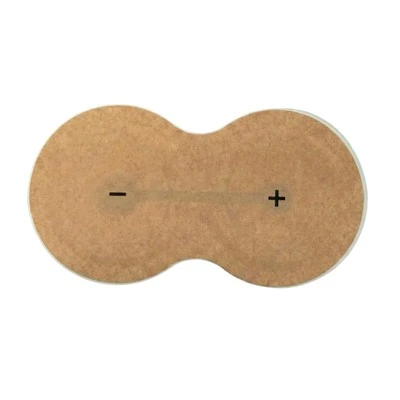

OEM Wireless Transdermal Drug Delivery Patches | Iontophoresis Patch | TOP-RANK
B2B contract manufacturing of wireless transdermal drug delivery patches. Features integrated zinc-air galvanic cells (80 mA-min dosage), Ag/AgCl non-hydrolytic redox chemistry, pH-locked drug reservoirs (pH 4.5 to 7.0), and sub-0.3 mA/cm2 current density.
Product Overview
The wireless transdermal drug delivery patch operates as a self-powered, wearable iontophoresis device engineered for localized, non-invasive transport of charged therapeutic molecules across the stratum corneum. The platform replaces hypodermic needles in orthopedic clinics, sports medicine facilities, and rheumatology departments for site-specific delivery of corticosteroids (e.g., dexamethasone sodium phosphate) and local anesthetics (e.g., lidocaine HCl). The entire electromechanical assembly-including the galvanic micro-battery, active current-limiting resistor, Ag/AgCl redox traces, and hydrogel drug reservoir-is enclosed within a single disposable skin adhesive patch, requiring no external leadwires, controllers, or desktop consoles.
Commercial transdermal and iontophoretic patches encounter three primary electrochemical and mechanical failure modes:
- Electrolytic Water Hydrolysis & Dermal Chemical Burns: When non-polarizing electrodes are absent, passing direct current (DC) through aqueous drug solutions decomposes water. At the anode, water oxidizes to generate hydronium ions (2H2O to O2 + 4H+ + 4e-), driving local pH below 2.0. At the cathode, water reduction generates hydroxyl ions (2H2O + 2e- to H2 + 2OH-), pushing local pH above 11.0. These extreme acid/base shifts trigger full-thickness chemical skin burns beneath the drug reservoir.
- Competing Background Electrolyte Depletion: High concentrations of mobile background ions (Na+, Cl-) in raw hydrogels reduce the target drug's transference number (ti). Because smaller physiological ions have higher electrophoretic mobility than large organic drug molecules, background salt ions carry over 85% of the total charge across the skin barrier, reducing drug delivery efficiency to less than 15%.
- Galvanic Atmospheric Self-Discharge: Patches using zinc-air chemistry suffer from atmospheric exposure during warehousing. Pinholes in barrier films allow ambient oxygen to leak into the zinc chamber, causing premature zinc oxidation, internal electrolyte drying, and premature battery failure prior to clinical use.
This wireless iontophoretic patch platform uses an active Ag/AgCl reversible redox couple that bypasses water hydrolysis entirely, holding reservoir pH between 4.5 and 7.0. The integrated zinc-air cell delivers an automated 80 mA-min dose (0.1 mA over 14 hours or 0.2 mA over 7 hours) at a current density under 0.3 mA/cm2. Drug reservoirs are cast from purified, desalinated polyacrylate matrices to maintain target molecule transference numbers above 60%. We contract-manufacture this platform for specialty pharmaceutical developers, clinical orthopedic brands, and private-label medical consumable distributors globally.
Technical & Engineering Description
The industrial manufacture of wireless transdermal drug delivery patches operates within ISO 13485-certified Class 8 cleanrooms utilizing continuous roll-to-roll screen printing and automated rotary converting lines. The monolithic patch consists of a 5-layer laminate: a water-impermeable closed-cell PE foam backing, a printed micro-circuit layer with an integrated current-limiting network, a zinc-air galvanic cell assembly, a pair of Ag/AgCl non-polarizing electrochemical reaction layers, and a microporous reservoir pad sealed by a differential fluorosilicone release film.
The printed electronics are laid down on a 50 um dimensionally stable polyester (PET) carrier film. The conductive traces are screen-printed using conductive silver ink (sheet resistance < 0.05 Ohm/sq) coupled with a carbon-thick-film resistor bridge tuned to match the internal impedance of the galvanic cell. This circuitry clamps current output to a continuous 0.10 mA without active semiconductors.
The electrochemical core uses a dual-electrode configuration:
For delivering negatively charged compounds (e.g., dexamethasone sodium phosphate, active valence -2), the drug chamber operates as the cathode. The cathode is screen-printed with a silver chloride (AgCl) layer (minimum salt coating density 2.5 mg/cm2), while the return counter-chamber (anode) is printed with metallic silver (Ag).
When circuit closure occurs, the cathode consumes electrons through the reversible solid-state reduction:
Concurrently, the anode releases electrons through silver oxidation:
Because the reduction potential of AgCl (+0.222V vs. SHE) is lower than the potential required for water electrolysis (+1.23V vs. SHE), current passes through solid-state precipitation and dissolution of silver salts. Water molecules remain un-cleaved, eliminating the generation of H+ and OH- ions and maintaining reservoir pH between 4.5 and 7.0 throughout the 14-hour delivery cycle.
The power module incorporates an ultra-thin zinc-air cell. The cell anode consists of amalgamated zinc powder suspended in a crosslinked polyacrylic acid potassium hydroxide (KOH) gel, while the cathode is a gas-diffusion catalytic membrane. The air access orifices are hermetically sealed beneath an oxygen-impermeable laminated pull-tab. Removing this tab allows ambient oxygen to diffuse into the cathode, initiating cell reaction:
This yields an open-circuit voltage of 1.40V to 1.45V with a discharge capacity exceeding 120 mAh.
The drug reservoir is die-cut from an inert, cross-linked, open-cell cellulose-polyvinyl alcohol (PVA) sponge pad holding up to 2.5 mL of liquid formulation without dripping. The perimeter is bounded by a 1.0 mm closed-cell PE foam ring coated with a biocompatible acrylic adhesive (peel strength 4.5N to 6.0N / 25 mm). Finished patches are sealed inside nitrogen-purged multi-layer PET/AL/PE barrier pouches containing oxygen scavengers. The standard OEM contract manufacturing minimum order is 10,000 patches.
Key Features
-
Ag/AgCl Non-Hydrolyzing Faradaic Electrochemistry (Preventing Acid/Base Shifts and Full-Thickness Chemical Burns)
When an electric current passes through an aqueous electrolyte using inert carbon or metallic foil electrodes, charge transfer is driven by the electrolysis of water. At the anode, water molecules donate electrons, generating hydronium ions (H3O+) and oxygen gas; at the cathode, water accepts electrons, generating hydroxide ions (OH-) and hydrogen gas. Over multi-hour wear, these reactions create localized pH extremes (pH < 2.0 at the anode; pH > 11.0 at the cathode). This drastic shift in skin surface pH causes localized protein denaturation, tissue necrosis, and chemical burns. We resolve this by printing the active and return electrode traces with a stoichiometric formulation of metallic silver (Ag) and silver chloride (AgCl). Charge transfer occurs through the low-energy conversion of silver and chloride ions (Ag +Cl- \leftrightarrow AgCl + e-), which operates at an electrochemical potential well below the threshold for water cleavage. Water molecules remain unreacted, suppressing the formation of free H+ and OH- ions. The fluid reservoir maintains an operating pH of 4.5 to 7.0 across 14 hours of continuous direct-current discharge, preserving epidermal barrier integrity without chemical irritation.
-
Pull-Tab Activated Zinc-Air Galvanic Source (Self-Regulated 80 mA-min Dosage Without External Controllers)
Conventional clinical iontophoresis systems require external, cable-connected benchtop power units. These cables tether the patient to a clinic chair, restrict physical movement, and create mechanical pulling forces that peel the electrode off the skin. Our wireless patch houses an integrated, flat-profile zinc-air micro-cell within the layers of the foam backing. The zinc-air battery provides an energy density of over 400 Wh/kg, packaging sufficient charge into an overall patch thickness under 2.5 mm. In storage, the cathode air access ports are sealed by an oxygen-barrier release film that prevents atmospheric oxygen from entering the cell, reducing shelf-life capacity degradation to under 2% per year. In the clinic, pulling the activation tab exposes the catalytic diffusion layer to air. Ambient oxygen acts as the battery reactant, initiating a stable 1.4V discharge. The battery feeds into a series thick-film resistor calibrated to hold current delivery to 0.10 mA across biological impedances up to 10,000 Ohm. The device delivers an exact 80 mA-min cumulative dose over 14 hours, allowing the patient to wear the patch home without external leadwires or battery packs.
-
Desalinated Low-Conductivity Polymer Sponge Reservoir (Maximized Transference Number for Macromolecular Drug Delivery)
The physical efficiency of transdermal iontophoresis is dictated by the transference number (ti) of the target drug ion:
ti = zi ui Ci\Σ zk uk CkWhere z is ionic valence, u is electrophoretic mobility, and $C$ is concentration. Standard commercial hydrogels contain high concentrations of residual sodium (Na+) and chloride (Cl^-) ions from polymerization buffers. Because these small inorganic ions have electrophoretic mobilities nearly five times greater than large therapeutic molecules (such as dexamethasone phosphate or lidocaine), they carry the bulk of the electrical current into the skin, dropping the drug's transference number below 0.15. We resolve this competitive transport bottleneck by fabricating the drug reservoir from an open-cell polyvinyl alcohol (PVA) and cellulose sponge matrix that undergoes multi-stage deionized water dialysis. Residual free ionic conductivity is purged below 5 uS/cm. When the clinician saturates the dry reservoir with the drug solution, the target drug ions act as the primary charged species in the chamber. The transference number of the therapeutic agent rises above 0.60, delivering higher transdermal molecular flux per milliampere-minute of electrical charge.
Applications
Outpatient Orthopedic & Sports Rehabilitation Suites
Targeted, needle-free transdermal delivery of dexamethasone sodium phosphate for non-invasive treatment of localized inflammatory conditions, including insertional Achilles tendonitis, lateral epicondylitis (tennis elbow), and acute plantar fasciitis.
Pediatric Oncology & Pre-Procedural Local Analgesia
Rapid needle-free transdermal delivery of lidocaine hydrochloride prior to lumbar punctures, pediatric venous port access, and peripheral intravenous (IV) cannulation, establishing deep cuticular anesthesia without the emotional trauma of hypodermic needle infiltration.
Rheumatoid Arthritis & Small-Joint Synovitis Care
Extended slow-perfusion corticosteroid delivery across superficial, low-adipose joint capsules (metacarpophalangeal joints, wrist, and anterior talocrural spaces), driving active anti-inflammatory molecules into target synovial fluid envelopes without systemic hormonal side effects.
OEM & Private Label
-
Custom Well Geometries, Formulation Pre-Filling & Blister Packaging : We provide custom tooling for active reservoir wells (volumes from 1.5 mL to 4.0 mL; circular, rectangular, or anatomically contoured butterfly geometries). Options include dry-reservoir formats (clinicians inject liquid medication immediately before application) or pre-filled, foil-sealed formulations for drug developer partners. Terminal adhesive rings can be converted using hypoallergenic hydrocolloid or water-resistant closed-cell PE foam. Finished patches are packed in nitrogen-flushed multi-layer PET/AL/PE barrier pouches with custom medical-grade multi-lingual printing and blister packaging.
-
Two-Center Supply Chain Mechanics : High-precision Ag/AgCl functional web printing, thick-film resistor deposition, zinc-air galvanic cell assembly, and automated drug-reservoir die-cutting execute natively inside our primary China facility. Secondary cleanroom assembly, blister packaging, multi-layer barrier foil nitrogen pouching, electronic lot verification, and export palletization route through our Vietnam hub, shielding international B2B buyers from regional medical consumable tariffs and Section 301 duties.
Certifications
-
ANSI/AAMI NS4 & IEC 60601-2-10 Electrical Rigor : Production master lots undergo validation testing in accredited independent testing laboratories confirming strict compliance with ANSI/AAMI NS4 (Transcutaneous electrical nerve stimulators / DC medical electrical equipment) and IEC 60601-2-10. Testing protocols confirm current output limits remain below 0.15 mA across the 14-hour duty cycle, maximum DC current density stays clamped below 0.3 mA/cm2, and no voltage overshoots occur during activation.
-
ISO 10993 Comprehensive Dermal Biocompatibility : Drug reservoirs, conductive traces, and outer adhesives undergo continuous batch evaluation against ISO 10993-5 (In Vitro Cytotoxicity Grade 0), ISO 10993-10 (Skin Sensitization: 0% allergic response), and ISO 10993-23 (Primary Dermal Irritation Index = 0.0). The complete assembly is 100% natural rubber latex-free, phthalate-free, and contains zero animal-derived adhesives.
-
MDSAP & ISO 13485 Certified Manufacturing Oversight : Screen printing suites, cell assembly bays, and pouch packaging lines operate strictly within facilities certified to ISO 13485:2016 and MDSAP regulatory frameworks (covering US FDA 21 CFR 820, Health Canada, TGA Australia). Unbroken electronic Device History Records (DHR) capture raw material lots, AgCl print mass densities, resistor calibration tolerances, and packaging barrier vacuum seal data.
Technical FAQ
Q: Why does delivering dexamethasone sodium phosphate require a cathodal drug chamber, and how does the anodal counter-electrode prevent local tissue irritation without active drug ions?
A: Dexamethasone sodium phosphate is a water-soluble ester that dissociates into a divalent negative dexamethasone phosphate ion (Dex-P²ˉ) and two sodium cations (2Na+). According to electro-repulsion principles, driving negative ions into tissue requires a negative electrical pole (the cathode). When current is applied, the negatively charged cathode repels the Dex-P²ˉ anions across the stratum corneum through water-filled paracellular lipid channels and skin appendages (eccrine sweat ducts and hair follicles). However, this leaves the return counter-electrode (the anode) in contact with non-medicated skin. In unoptimized systems, this anode draws endogenous chloride (Cl-) and cellular anions out of the skin; if driven across inert metals, it hydrolyzes water into acid, causing severe anodal chemical burns. We resolve this by packing the return anodal chamber with a neutral physiological buffer gel containing an immobilized, high-purity metallic silver (Ag) formulation. When current flows, the anode undergoes the solid-state oxidation Ag + Cl- to AgCl + e-, drawing chloride ions from the gel without generating free H+ ions or depleting tissue structures. The local pH at the return electrode remains between 6.0 and 7.0 throughout the 14-hour wear cycle, preventing counter-site burns.
Q: How does the Ag/AgCl redox reaction suppress water electrolysis, and what happens to the electrode interface if chloride ions are depleted?
If a clinician hydrates the patch with non-chlorinated sterile deionized water instead of saline, or if the drug formulation contains zero chloride counter-ions, the interface runs out of chloride reactants. Once the local chloride is exhausted, the anode potential spikes past +1.23V, water electrolysis begins, and the skin begins to burn. To ensure fail-safe performance even if a user makes a fluid error, our dry absorbent well is pre-impregnated during factory manufacturing with a lyophilized, micro-encapsulated sodium chloride buffer salt layer. Even if hydrated with chloride-free solution, the dry salt cake dissolves instantly, supplying the chloride ions needed to keep the Ag/AgCl reaction running and keeping interface pH neutral throughout the entire treatment cycle.
Pharmaceutical formulation directors, transdermal technology licensing leads, and sports medicine consumable distributors can request complete in-vitro Franz cell transdermal flux logs, ISO 10993 dermal biocompatibility dossiers, and unbranded 40 mA-min / 80 mA-min wireless evaluation patches with filling syringe kits.
👉 [Request Wireless Transdermal Delivery Patch Evaluation Kits]
Hot Tags: wireless transdermal drug delivery patches, China wireless transdermal drug delivery patches manufacturers, suppliers, factory, dexamethasone for iontophoresis patch, iomed patch, ionto pads, iontophoresis cortisone patch, Iontophoresis Pad, Iontophoresis Patches
Specifications
| Analytical Parameter | Engineering Baseline | Testing Standard |
| Operational Standard | ANSI/AAMI NS4, IEC 60601-2-10 (Electromedical DC limits) | Medical electrical DC limits |
| Patch Geometry | Integrated Dual-Chamber Butterfly (Active + Return) | Monolithic patch |
| Drug Reservoir Volume | 1.5 mL to 3.0 mL Liquid Fill (Anode or Cathode) | Absorbent polymer well |
| Active Reservoir Area | 6.0 cm2 to 12.0 cm2 (Current density < 0.3 mA/cm2) | Strict DC safety boundary |
| Power Source | Integrated Zinc-Air Galvanic Micro-Cell (1.4V to 3.0V) | Pull-tab air activation |
| Delivery Dosage | 80 mA-min (Option for 40 mA-min short wear) | Microprocessor / resistor fixed |
| Current Output | 0.10 mA (+/- 10%) Continuous DC (14-Hour Wear Window) | Extended slow iontophoresis |
| Electrode Chemistry | High-Capacity Screen-Printed Ag and Ag/AgCl Inks | Reversible redox pair |
| Reservoir Operating pH | Maintained strictly between pH 4.5 and pH 7.0 | In-vitro 14h DC monitoring |
| Substrate Backing | 1.0 mm Medical Closed-Cell Polyethylene (PE) Foam | Fluid-barrier |
| Skin Adhesion | 4.5N to 6.0N / 25 mm on Stainless Steel Coupon | ASTM D3330 |
| Drug Compatibility | Anionic (Dexamethasone Phosphate) & Cationic (Lidocaine) | Dual-polarity configurations |
| Shelf Life Stability | 24 Months at 15C to 25C in De-Oxygenated Barrier Pouch | Nitrogen-flushed PET/AL/PE |